Exclusive Interview : Joel Eckhaus

JOEL ECKHAUS began building instruments in 1973. He opened a shop in 1976, and has been playing, teaching, designing, building, and repairing string instruments ever since. His woodworking experience also includes sailboat repair and construction, home renovation, nickelodeon construction, whirligig design and production, fine furniture and cabinetmaking, and production lutherie with Dana Bourgeois Guitars. Joel has a BS degree in vocational education and currently teaches woodworking and instrument making at Maine College of Art.

In addition to being a luthier, Joel also plays the mandolin, tenor guitar and banjo, ukulele, and musical saw. He studied uke and banjo with former vaudevillian, Roy Smeck, the “Wizard of the Strings”, and studied mandolin with former Texas Playboy, Tiny Moore. He was a founding member of the Arm and Hammer String Band, and has performed with the New York Banjo Ensemble, the Howitzer Mandolin Orchestra, the Neverly Brothers, the Blue Sky Serenaders, the New England New Vaudeville Review and the Pinetones. He currently plays with the ukabilly duo Dos Eckies; a ukulele/tap dance duo, Ham & Legs; and his own group, Ukulele Eck and the Fabulous Lacklusters.

You can find out more about his instruments and contact him at the Earnest Instruments website

Ukes have become very popular over the last few years. Most people who like them play acoustic ukes. What inspired you to make electric ukuleles?

The short answer is….”why not?”

The longer answer is that instruments evolve. Before the 1930’s there were no electric guitars, but they were quickly accepted in the guitar community. They filled a need for louder instruments, and eventually helped to create entire new vocabularies and styles of music.

I used to think that ukes had to be acoustic, reentrant, and have nylon strings, but the cavaquinho, which evolved from similar portuguese roots, broke those rules long ago. Many players from Brazil and Cape Verde still refer to them as ukuleles.

The music has evolved too. Ukes are no longer limited just to Hawaiian music. They were quickly adapted in the early teens and twenties to popular music, and since then have been heard in ragtime, jazz, folk, country, classical, and rock music. It seems like a natural evolution to add solid body electric ukes to the musical palette.
Your ukes (and other instruments) are very unique. What are the most important parts of the build process for you?

I look at all the old ukes as well as other instruments and use ideas, shapes, styles, and materials in my design process. I’m trying to get away from building copies of other instruments, both for legal reasons and because I prefer building my own designs.

With acoustic ukes, I really try to keep things lightweight, more so than many of the imported ukes I see. The wood is thinner, the braces are smaller, even the kerfing is less massive. With electrics I favor lighter bodies too. Mahogany and swamp ash are not as dense as maple, or rosewood. I want to bring out the “bass” in a uke. Heavy woods tend to be sound too brittle or bright.

If you could make a uke for someone in specific, who would it be and what special features would you include?

I’d like to see more of my own designs getting used in pop music as well as other styles. Eddie Vedder plays one of my Tululeles, based on a Telecaster shape, and John King played a Stradelele, based on a Stradivarius guitar. Both are my adaptations of a classic shape transferred to a uke. A few of my designs, like the Sputnik and the Boomerang, are original shapes based on 50’s and early 60’s electrics. I’m currently working with a friend to design and build an acoustic/electric uke for Merrill Garbus of Tuneyards.

Which materials do you prefer when you build bodies and necks? What ones should builders avoid?

I like mahogany a lot. It’s strong and light, but not too dense or hard. Ukes are pretty small and high pitched. I want to bring out the “low” end of the uke. Koa is brighter but can be loud and clear when it’s thinned out. I’ve used ash for the Tululele and the Paddlelele and I think its a great tonewood. More and more I use spruce for the tops, especially with the denser back woods like maple, rosewood, walnut, etc.

Sourcing four string parts such as bridges and pickups can be very difficult. What’s your approach with these?

I make some parts like bridges, neck plates, and coverplates out of nickel silver sheet stock. With a bandsaw, drill press and various sanders, I can make many small parts. The nickel silver polishes nicely and I don’t need to have the parts plated. I also use standard guitar bridges and tailpieces one four and sometimes five string instruments.
I buy stock guitar pickups for most of my electric mandolins, tenors guitars and ukes. To have the pickups custom made would be too expensive, and I don’t have the time, interest or equipment to make my own pickups.

What’s your most important luthier tool? Do you use cnc or power tools at any stage?

Most important tool is probably my thickness sander. Getting tops ,back and sides to their optimal thickness quickly is important. Leveling inlays and sanding figured wood to thickness is made so much simpler with it.

I have most of the standard woodworking machines as well as many hand tools. I don’t own or operate a CNC machine, but I have had some parts made on CNC by people that specialize in that work. The necks and bodies of my concert Tululeles were made by CNC. Any custom inlay work…blocks, names, logos is usually done by CNC inlay shops, I hate cutting, and inlaying pearl, except for dots. I don’t even really like the way a heavily inlayed instrument looks.

Do you play or build other instruments too? How does your uke building knowledge transfer to them and vice versa? Are there common techniques?

I also play and build acoustic and electric mandolins, tenors guitars and do some repairs and restorations. I’ve built some more unusual custom instruments as well, electric dulcimers, walking stick ukes, painted ukes, It’s all lutherie, just different instruments. My knowledge of instrument history is important. I’ve looked at a lot of instruments in museums, stores, guitar shows, books, wherever. Everyplace I go, I try to find out something about the local music and it’s instruments. I took Charango lessons in Argentina, and heard some great Russian balalaika playing in Spain.

When it comes to electrical components, how do you prefer to configure them? Have you ever tried different pots / resistors / pickups in the same uke to compare the sounds? What wins it for you?

My knowledge of electronics is minimal. I can follow a diagram and wire up most configurations, sometimes with a lot of head scratching. I usually buy Kent Armstrong pickups because they’re relatively cheap and reliable. If someone requests a pricier pickup, I’m happy to get it for them. I like 2 pickup instruments the best. I can get all the sounds I need from 2 pickups. I done a few 3 pickup tenors, and sometimes with some sort of bridge transducer as well. I prefer to keep it simple.

If you could have played electric uke on one classic rock or blues track which would it be?

We’ll I play a lot of old Rock ‘n Roll in my uke-abilly duo, dos Eckies, with my friend, Kris Eckhardt. Kris played in a local rockabilly band called King Memphis, that played a festival in England a few years back. We do Elvis, the Everly’s, Buddy Holly, Ricky Nelson, Chuck Berry, and more. Kris has a great electric guitar style that he transfers to the uke, He’s also built a Whammy bar for his Tululele which works pretty good.

So the tune I’d like to learn next is probably the Kink’s “You Really Got Me”

Exclusive Interview : Peter Howlett

There is a photo of Peter Howlett with his first ukulele, a plastic Woolworth’s ukulele, at the tender age of 4. He has been into ukulele’s ever since and now builds and teaches others how to build them. He build’s ukuleles from only the finest woods available either as acoustic or electric. He has made over 500 ukulele’s to date, that are played throughout the world by professionals, collectors and amateurs alike.

We were lucky enough to interview him and ask him all about his build process. At the bottom of this article, you will find his series of Uklectic (electric ukulele) build video’s on you tube.

You can find out more about Peter Howlett and the ukuleles he builds, his concert and tenor ukulectic‘s, or the ukulele building courses he runs over on his website.

Ukes have become very popular over the last few years. Most people who like them play acoustic ukes. What inspired you to make electric ukuleles?Like all designers I have a head full of ideas – this was one of them, to answer the bried of playing venues with a ukulele at high volume with no feedback

Your ukes (and other instruments) are very unique. What are the most important parts of the build process for you?
Wood choice. Most people buy or like with their eyes so my instruments have as their primary ‘hook’ fantastic and expensive face woods

If you could make a uke for someone in specific, who would it be and what special features would you include?
I’ve already done this many times. My most recent piece went to Bluesman Catfish Keith – a tenor resonator ukulele in birdseye maple veneer with tortoise binding and art deco hbound headstock. The whole thing had a 1930s vibe…

Which materials do you prefer when you build bodies and necks? What ones should builders avoid?

Spanish cedar – nice and light. Avoid African woods because of the spiral growth. I am looking at using European alder for builds next year.

Sourcing four string parts such as bridges and pickups can be very difficult. What’s your approach with these?
I wimp out and use piezos in a standard acoustic style pin or tie bridge because my instruments are nylon strung.

What’s your most important luthier tool? Do you use cnc or power tools at any stage?

My Sabatier knife made from surgical steel. I could make and entire instrument with this just about.

Do you play or build other instruments too? How does your uke building knowledge transfer to them and vice versa? Are there common techniques?

Everything I do is informed by the furniture making I did back in the 1980s and the guitar making I did between 1994 and 2001. However the greatest influence has been my religious beliefs which can be best defined as “Hands to work – hearts to God”. With that in mind, every build is conducted with an eye to making it as perfect as possible in design and execution. Those long ago learnt hand skills are what makes a Pete Howlett Ukulele what it is – a dedication to a Creator who provided me with raw beauty and perfection with which to futher honour Him. (probably not the answer you were looking for eh?)

When it comes to electrical components, how do you prefer to configure them? Have you ever tried different pots / resistors / pickups in the same uke to compare the sounds? What wins it for you?I’ve never tried these although I am building a 5 string bass ukulele with fibre optic lit side dots and an on – board pre-amp. Richard Cross of Shapely Wood has helped me with the electrics on this build – check out his ukulele…

If you could have played electric uke on one classic rock or blues track which would it be?

I don’t class myself as an electric player – my technique is too heavy handed. However I admire many players and since I have loved the Clapton/Mayall ‘Beano’ album since I bought it as a kid vinyl when it first came out I’d have to say Hideaway, Eric’s version…. Although I would dearly love to show him how to play Hey Hey by Big Bill Broonzy properly

Continue reading

Tearcaster uke build : part 03 – Pickup and Bridge custom parts

As I am sure you can imagine, finding good pickups for an electric ukulele is a tricky business. Off the shelf options are limited, with most people I know suggesting P-bass pickups. See the problem here? they are designed for bass guitars… not for ukes. You can look at electric mandolin pickups, you can look at hot rail pickups, you can use a guitar pickup. Not one of these solutions looks right though, and I am sure that sound performance will be held back. I got lucky with mine. I found a real nice guy called Pete Mallinson at Almuse and he makes custom links to match your requirements. And he really knows his stuff. This is the single coil pickup he made for the Tearcaster uke :-

It is a fully custom design. 4 pole, 12mm string spacing, with the re-entrant gCEA tuning in mind, meaning that the ‘g’ pole is the right size for a high ‘g’ string. Not only this, but Pete gave a choice of colours, a choice of clockwise/anti-clockwise and a choice of N/S or S/N polarity. If I wanted anything else out of the ordinary, all I had to do was ask. He will happily make you different rated pickups for bridge and neck too, if you are ordering a pair. How cool is that?

In addition, Pete also provided one of the hardest parts for me to locate, the 4 string bridge plate. This takes standard Fender style bridge saddles that you can salvage from any ol’ strat or tele bridge, both of which are cheap as chips on ebay now. In the photo here, the saddles are in need of a clean up, but I just screwed them on quickly so you could all see how nice a fit they are.

Pete is a real gent and I get the feeling he loves his work. He was happy to help me get all the details right and even offered up some other ideas (more on that in another post). You can get current prices for his stuff from the site, but really don’t be afraid to mail him with your requirements.

I just can’t wait to get this all wired up and shredding now. Only I do need to find a body for the Tearcaster uke first. That would seem like the logical thing to do for pt 04.

SU uke build : part 06 – Body cut

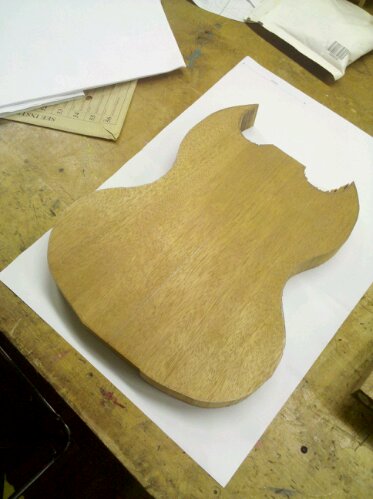
Bit of a cheat on my part this one. For health and safety reasons, I am not allowed to use machinery at guitar school. I jumped out of an aeroplane last week, at 13,000ft, with zero experience but sadly, I cannot even look sideways at a band saw with out getting the H&S crew smashing down my classroom door.

So, to take the piece of wood from where it was, to a ukulele shape, I em…. let my teacher, Mike, take it home and bandsaw it for me. Not how I wanted it to happen, but for the best at the moment. Thanks Mike…. I can move on now…

image

image

Lidl Electric Uke Hack : part 01 – the plan

Just the other day, I spotted a review of an £18 Ukulele on
Barry Maz’s “Got a Ukulele?” website. He reckons this cheap ukulele from Lidl isn’t that bad. I have been thinking about drilling into a Uke to add a piezo pickup for some time, but really didn’t wan’t to mess up any of my good ukes, as I have never done this before. £18 isn’t the end of the world if things go wrong.

So on Friday, I marched around to Lidl’s and bought this :-

image

Yesterday, while I was in the West end of London, I took another piece of advice from Barry’s review and grabbed a set of Aquila Soprano strings.

Then, I ordered up this kit from a seller called mosong_music on ebay. Ok, so it is in Hong Kong and will take a while to arrive, but £11.77 inclusive of postage was worth a gamble.

And finally, when it is all fitted, I shall be plugging it into my smokey amp (named so as it used to be built inside cigarette packets) :-