I’ve made instruments out of all sorts of stuff. When I saw an old skateboard deck at a garage sale, I had to have it. I thought it would make the perfect body for an electric ukulele.
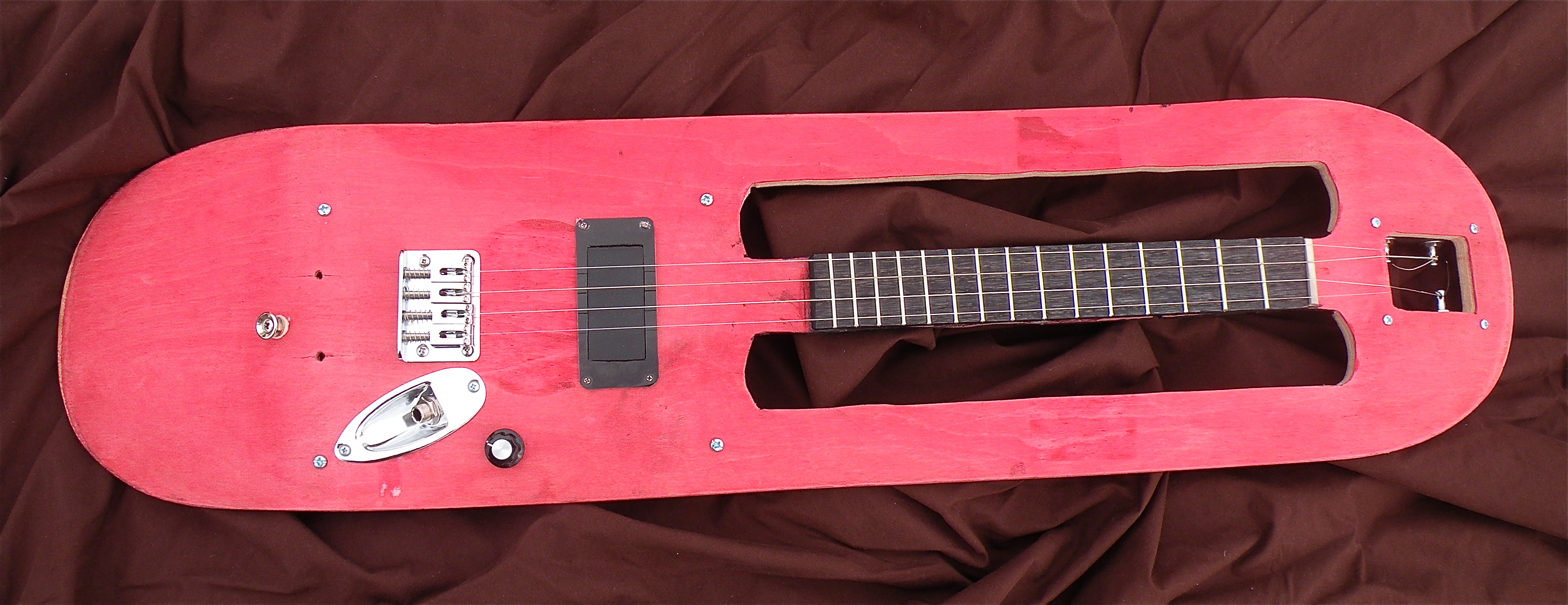
Because both ends curve back, I didn’t have to do anything to angle the headstock. Using a scroll saw, I cut out the space for the neck, headstock, pickup, and Stratocaster-style jack plate. I kept the wood above and below the neck to give the instrument more stability and to the keep overall shape of the skateboard. A fretboard with a 17 inch scale was epoxied to the neck.
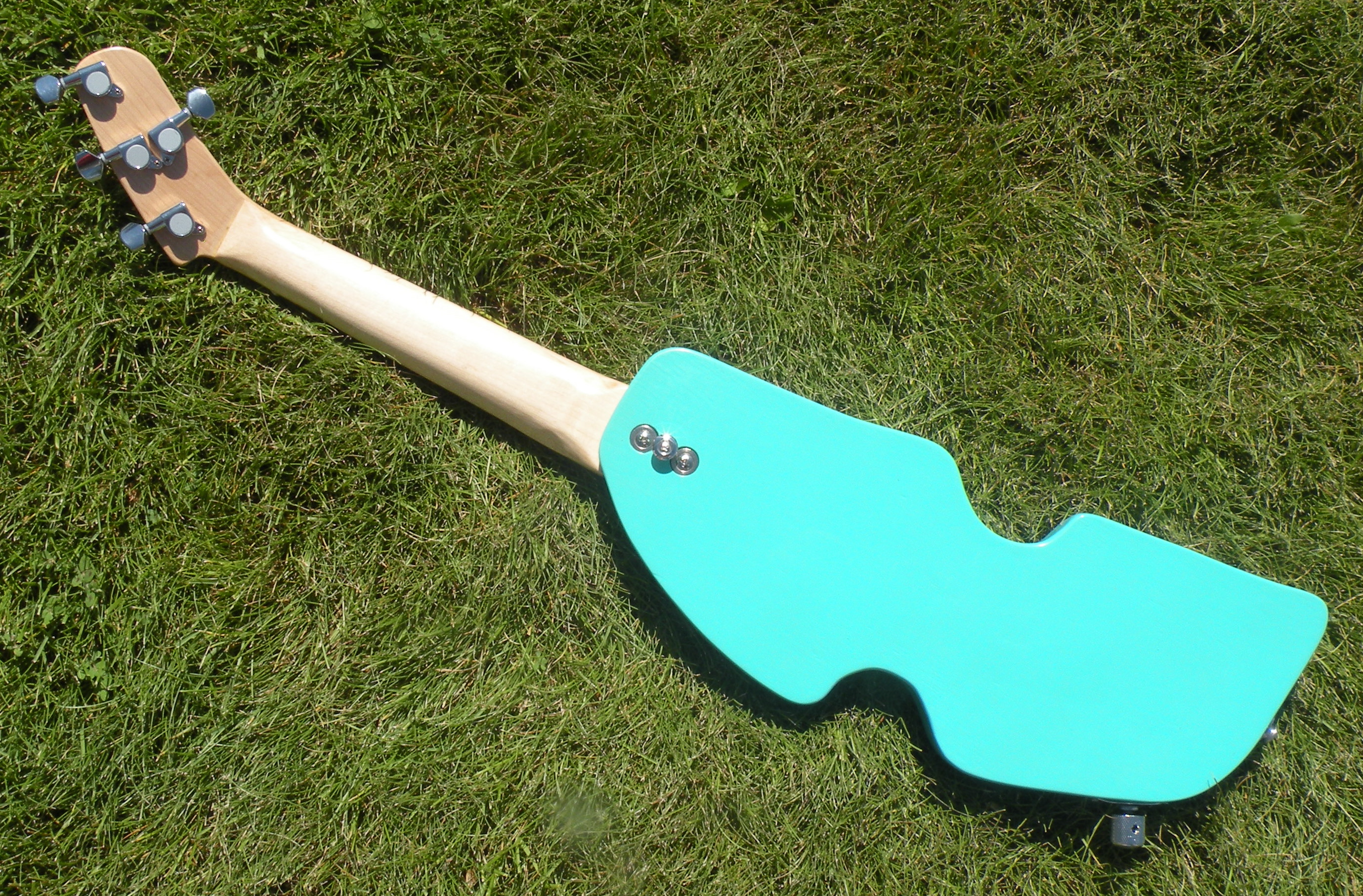
Most of the grip tape was left on the board. I stripped the grip tape from the bak of the neck. I was going to add about 1/4 inch of wood to the back of the neck, but that would have made it too thick. Instead, I just carved the neck a little bit and stained it black. A board with rounded over edges was attached to the back to cover the wiring and components.
Out of all the electric ukuleles that I’ve made, this was the fastest to make. Not having to rout out the body, carve and shape the neck, and apply a glossy finish really cut down on the build time.
I wanted to make a ukulele with the longest possible scale that would still fit in my travel case.
Before staining the body, I made sure that everything fit properly.
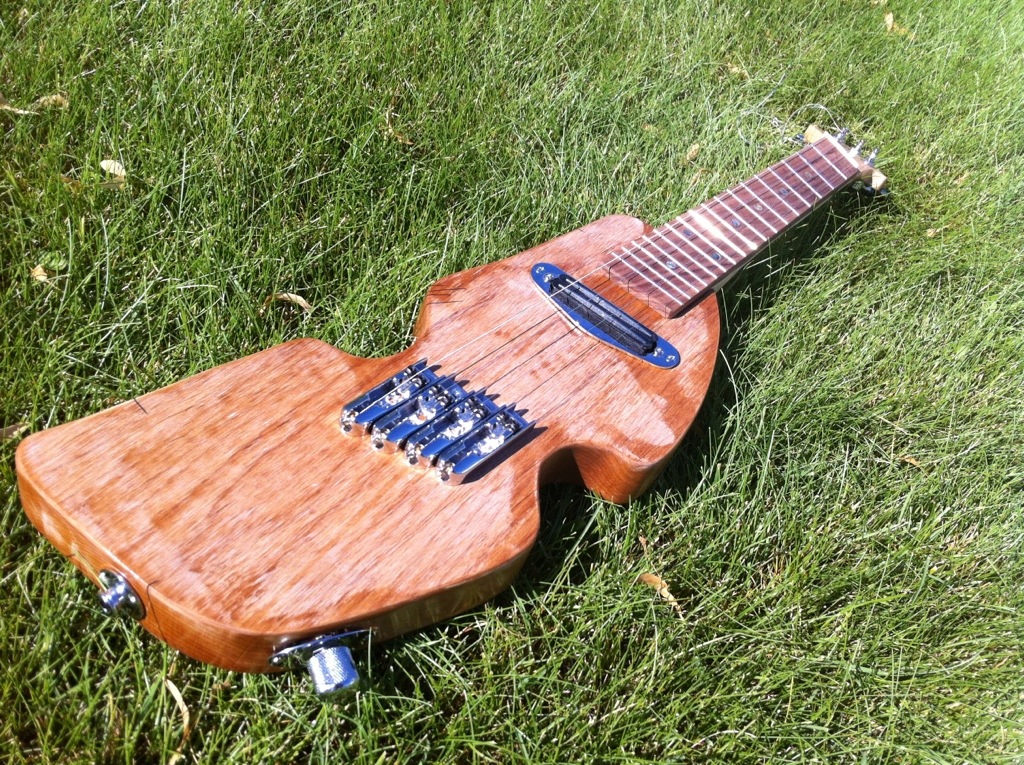
The “Les Paul” style body was made with a single piece of cherry wood. The scale length is 19 inches, and its overall length is 21.5 inches. Even though the scale length is 19 inches, I tune it like a reentrant tenor/concert/soprano. I prefer that tuning and it works better with most of the ukulele sheet music that I have.
The fretboard and bridge are made of rosewood. The volume knob is made of ebony. A piece of plastic pipe directs the strings back towards the tuners.
I used transparent red nitrocellulose lacquer followed by nitrocellulose clear coat to give it a finish similar to Gibson’s “Heritage Cherry” finish.
The under saddle piezo pickup is soldered to a 500K ohm potentiometer to control the volume. The output jack is attached to an upside down stratocaster style jack plate.
Ukuleles are already very portable, but the bumps and bruises of travel can wreak havoc on acoustic instruments. I’ve already constructed a few travel ukuleles. The first was a prototype (Home Depot Travel Ukulele). The second ukulele improved upon the first (DIY Travel Ukulele). Both of these solutions only required basic tools along with common parts and wood.
After slowly acquiring more tools and expertise, I wanted to make another travel ukulele. I took the things that I learned from the other builds and implemented them in this travel ukulele.
I started out by sketching out the design on paper. The scale length was 15 inches (concert scale). There were two tuners on each side using a slotted, classical style.
At a specialty hardwood store, I picked up a beautiful 1.5 in X 5 in (3.8 cm X 12.7cm) piece of hard maple.
The outline and interior were cut with a scroll saw. The overall length of the wood is a little over 20 inches. The widest point is 2.5 inches, and it is 1.5 inches thick.
I slotted the frets, rounded over all of the edges except for the fretboard, drilled all of the holes, and spokeshaved the neck until it was comfortable. The entire assembly was then given a few coats of nitrocellulose lacquer. The lacquer finish really brought out the natural beauty of the wood.
After the strings go over the bridge, they need to be directed back towards the tuners. I used a handful of nylon spacers and washers along with some “Chicago bolts” (I also saw them referred to as “barrel nuts”) to direct the strings.
The bridge is a small aluminium tube that was attached to the body with two metal cable clamps.
A rod piezo was inserted into the rod. The wires from the piezo were fed through a small hole drilled into the jack cavity.
This pickup is very responsive. The combination of the lightweight, but rigid, aluminium and the rod piezo work well together.
The piezo wires were soldered directly to a 1/4 inch mono jack.
It’s ready for strings. I decided to use some of D’Addario’s new T2 Titanium acoustic ukulele strings. They are “bright” sounding strings that are working great for this application. In addition, they are transparent with a pleasant purplish tint which add a bit of razzle-dazzle to the end product.
The travel ukulele is complete. With all of the hardware, it is 20.5 inches long, 3 inches wide, and 2 inches thick. I’m very pleased with how it turned out. I set out to make a sturdy and portable ukulele, and I met my goal. Not only is it a legitimate instrument, it could also fend off zombies, or serve as a cricket bat in a pinch.
To see more of my videos, subscribe to my YouTube channel (Circuits and Strings).
Sometimes the desire to ROCK is tempered by a lack of tools. To make a regular solid body electric ukulele, you need a scroll saw (or a band saw) and a router along with some other basic tools. However, a hollow enclosure can be used for the body, which eliminates the need to cut and rout a wooden body.
For my ukulele, I used an ammo box that I purchased at an army surplus store. This same kind of thing could be done with any type of sturdy wood, metal, or plastic box.
The neck was made with two pieces of mahogany scarf jointed together. Less expensive and more readily available wood could also be used. In fact, other types of wood would probably be more congruent with the “DIY spirit”.
In keeping with the ammunition theme, many of the hardware appointments were made with spent bullet shells. One the most difficult parts of this build was cutting a hole in the thick metal box for the single coil pickup. I used a hacksaw blade and a file to do this. A jig saw would have been much easier.
The bridge was made with a 30.06 shell. A shotgun shell top serves as the volume knob.